The first thing you need
to do is create a distraction "free" zone. If you can't rent space
somewhere else, like an office, find a space that you can work
uninterrupted for a decent amount of time. Obviously this means you need
to turn off your cell phone and email notifications, close all
unnecessary windows, tabs and don't check Facebook and other social
media.
If your distraction free zone is at home, turn off the TV.
Even though you may like the "white noise" that the TV provides in the
background, turn it off.
Also, let your friends and family know
that you need this specific space to be yours to work. They need to
understand that this is a zone for optimal productivity and that you ask
they respect that space.
Then close the door to your office and get to work.
2) Separate Life From Work And Work From Life
Once
you've found your distraction free zone, next you need to create a
workspace separate from everything else. This is especially important if
you have to, or choose to, work from home.
Research shows that a
change of venue sparks something in us, it creates a sense of difference
than our normal routine. Getting up and moving to a new workplace, some
new site, makes a part of our brain activate in a way that's different.
It's the stimulus of this new environment that helps spark a drive and
energy toward our production.
3) Measure Once, Cut Twice
Now
that you have a work space and people understand the importance of your
work, cut it down to size. Take any large projects you have and break
them down into smaller, more manageable pieces.
In carpentry,
there's an adage to "measure twice, cut once." To gain the most from
this exercise, you should flip these two concepts on their head.
Measure
once, see the size and scope of the project and cut it down to as small
a portion as possible. Another tip is to make a list of what you need
to do, how many steps you predict it will take and set about one step at
a time.
4) Time Your Work
Dedicate your time - you've gone this far in learning to maximize your output, don't take a short cut now.
Commit
yourself to working in short, highly focused periods of time. This
concept, otherwise known as the Pomodoro Technique, is a proven
productivity technique used in many industries.
What it instructs
us to do is: set limits on the length of time you plan on working and
make sure you have very clear boundaries that include breaks in the
intervals. It's roughly 80% work, 20% recovery. Plan to start in small
increments, 20 minutes of work and 5 minutes of rest from that task.
Don't make the mistake of extending your time. When you're done with
your 20 minutes, you're done. Take a 5 minute break without
interruption. You'll come back to your task refreshed and ready to go.
5) Go Granular To Build A Mountain
Think
about a car. There's the obvious moving parts, the wheels, the pistons
in the engine, etc. But if all the nuts and bolts, all the screws are
tight, things fall apart.
How this applies to you, is that you
should think about your work as little minor tasks to accomplish and
that over time these micro-accomplishments will add up to something
greater. Indeed, the sum is greater than the parts - but focus on the
parts that matter.
By focusing all your energy on the small things, they have a way to add up over time.
6) Just Say No!
Learn
to say NO. Too many of us are willing to take on tasks and challenges
from co-workers, clients and loved ones that take us away from our
goals. So learn to say no.
There's always more to get done and more than you can ever hope to accomplish.
Obviously
there's only so much time in the day, and you only have a finite
quantity of energy to get your tasks accomplished, so know when to say
when. Or in other words, "no."
It may take awhile for clients,
family and friends to learn this from you, but eventually, they'll learn
that by you saying no to their every demand and whim, you'll be happier
and more productive over the long-term.
It's not easy to do but critical for success.
Be willing to say no will free you up with extra time and energy to focus on the tasks most critical and important to you.
7) Know When To Yield And When To Stop
As we discussed earlier, learn to set limits.
It's a tactic that will help you break down your tasks into simpler, manageable ways.
Your tasks are the vehicle, the engine of your success.
But like an engine, it requires maintenance, upkeep and can't be run forever without breaking down.
Don't just work for the sake of work. Make it a priority to stop when you should and rest when it's time.
Most importantly - DO NOT VEER OFF YOUR PATH - No U-Turns.
Taking decisive action in granular ways will lead you toward the goals you want.
Regardless of your goals, these 7 tips you can use right now will maximize your productivity for all the time you have left.
Do you sometimes (or always) feel like you have too much to do and too little time to do it?
Consider an email I got from a student the other day:
“… as the semester goes by, the harder it is to keep up with
school. The thing is, I know I’d be able to do it if I didn’t have any
extracurricular activities. I have a weekend job where I teach youths, a
youth group where I currently lead social justice, and I was just asked
by someone to lead prayer group. “Right now, the only way to do everything is to sleep less
and work more, but I noticed that I can’t do much when I haven’t gotten
much sleep. I wanted to take care of my body as well so I’ve been
sleeping normally these past few days. Now I’m behind everything again; I
have two big assignments due and midterms next week.” I know this feeling, because that’s how I felt before I started
simplifying my life. I was being pulled in all directions, and never had
enough time for everything I needed to do. I wanted to do a great job
with each role I’d taken on, and felt I could do it, but really I was
doing a bad job at everything because I was stretched too thin. To this student, and to everyone else who feels this way, I’d say this: your plate is too full. You have too much going on. The only answer, unless you want your health to decline (and that’s not good for anyone), is to start saying No.
The Whys of Saying No
You have to say No to at least a couple things on your list: say No
to prayer group and the youth group, so that you can say Yes to school
and the job. For anyone else reading this, you might have to say No to certain
work projects, or community groups, or committees or boards or
parent-teacher organizations or coaching sports or some other worthwhile
activity. I know, it seems horrible to say No when these are very worthy things to do. It kills you to say No. But the alternative is that you’re going to do a bad job at each one,
and be stressed beyond your limits, and not be able to focus on any
one. You won’t be getting enough sleep, your focus will get worse
because of a lack of sleep, and stress will compound that problem. We stay in this state because we really want to do it all. We have
this idea that we can be great at everything, and succeed at all that we
try. But we are human, and we have limits, and we have to let go of
this idea of doing everything and doing it well. You’re either going to
do a couple things well, or do everything poorly.
Do a Couple Things Well
Ideally, you’d find complete focus and do one thing well. You’d pick
one really important thing, say No to all the rest, and put your
complete focus on this one project. This might be school, or a project
at work, or a volunteer project … but just one thing. You’d learn to do
it well, and get better and better at it, and serve people
exceptionally. However, that’s not reality. We can’t always pare things down to one
thing, so focus on two. I’ve found that you can do two things well, and
one thing really well. With two focuses, you won’t be as concentrated,
won’t learn as deeply, but it’s doable. With three or four focuses, you
won’t do anything well or learn anything deeply or serve anyone
exceptionally. So start paring down to two things: figure out what the most
important two things in your life are, and cut out the rest. Be
ruthless. Call or email or meet with them now, and tell them that you
really want to help, but your plate is too full. You can’t serve them
well, so you need to say No. When you’re down to two things, I’ve found it best to give each some
allotted time. So a few hours for one, and then a few hours for the
other. Don’t switch back and forth constantly between the two (an email
for one, write a paragraph for the other, go back to email for the first
one, a paragraph for the second, and so on). Doing it that way means
you never give either your full concentration. When you give something
your focus, really be present. Saying No to worthwhile projects, and letting go of the idea that we
can do everything, is very difficult. But it’s not more difficult than
trying to do everything and not getting enough sleep and being overly
stressed out. Saying No is hard, but it means you say Yes to focus and
sanity.
Are you a happy person? How often do you think of reasons why
everyone around you is successful though they are not better than you in
general? What do you do wrong?
Success comes to those who wait, they say. As far as you understand,
simple waiting is not enough to bring you luck, happiness and success.
So, maybe it is high time to change your attitude to everything and
everyone around, and stop doing those things that prevent you from
becoming successful?
What are they actually?
1. Do not let others decide what “success” is for you.
Different people may interpret “success” in different ways: some of
them measure it in money, other ones – in positive changes to people
around them and the world in general. If you want to be successful, do
not let others force their interpretation of success on you; do not
worry about what other people think, and come after what makes you
happy.
2. Do not believe anything without questioning it.
Successful people do not just accept any new information to be true.
They are critical thinkers, and they understand that we all (even
“qualified” sources) are ruled by our prejudices; so, they will always
question new information and maintain some healthy skepticism.
3. Do not worry about all unpredictable things that may happen to you.
If you want to be successful, stop thinking about everything that MAY
happen to you. Try to feel comfortable with the reality and accept the
fact your future can’t be predicted. Be ready to improvise and change
your deeds and decisions when things suddenly don’t go according to your
plan.
4. Do not feel stressed or depressed about criticism.
Try to stay calm and pay no attention to negative comments or
personal attacks you may get from others online. Successful people are
concentrated on making this world and people better, but they will never
respond to every comment they get from foes.
5. Do not expect success to come easy or quickly.
Successful people understand there can’t be any universal scheme on
becoming rich, slim, loved, etc. Do not expect that all those “lose 10
kilos for 3 days” or “get rich in a month” will work for you: you are an
individual, you have your own pace, you should find your own way to
your success.
6. Do not wait for the “right time” to do anything.
Do not hesitate chasing your ambition, because there will never be
the “right time” to do anything. Successful people perfectly understand
this fact, and you would probably agree with it when you tried to
remember how many times you postponed doing things after telling
yourself something like “it’s not a right time for this now”.
7. Do not ignore problems.
Successful people never ignore or avoid problems, no matter how big
and awful they seem; because they understand: if they put a problem off
it will not disappear but turn into a bigger one. So, try to confront
your pressing concern as soon as possible.
8. Do not be afraid of responsibility.
There can’t be a successful person without responsibility. Yes, we
all are people and we all make mistakes, but if you want to be
successful you should always accept responsibility for your words and
actions.
9. Do not care about what other people think of you.
As far as we all know, it’s impossible to please all the people who
surround us. Your attempts to become “good” for everyone will turn into
nothing but new worries, stresses, and problems. Successful people do
not concentrate on quantity of people to please, but worry about their
quality and focus on developing friendships with people they really care
about.
10. Do not forget people who are important to you.
It does not matter how busy a successful person is, they will always
find time to care about their families, friends, and all other people
who are really important to them. Your business can’t be an excuse of
your indifference.
Success is good, but you should understand that life will get depressing without friendship and love.
In 1687, Sir Isaac Newton published his groundbreaking book, The Principia: Mathematical Principles of Natural Philosophy,
which described his three laws of motion. In the process, Newton laid
the foundation for classical mechanics and redefined the way the world
looked at physics and science. What most people don’t know, however, is that Newton’s three laws of
motion can be used as an interesting analogy for increasing your
productivity, simplifying your work, and improving your life. Allow me to present this analogy as Newton’s Laws of Productivity.
Newton’s First Law of Productivity
First Law of Motion: An object either
remains at rest or continues to move at a constant velocity, unless
acted upon by an external force. (i.e. Objects in motion tend to stay in
motion. Objects at rest tend to stay at rest.)
In many ways procrastination is a fundamental law of the universe.
It’s Newton’s first law applied to productivity. Objects at rest tend to
stay at rest. The good news? It works the other way too. Objects in motion tend to
stay in motion. When it comes to being productive, this means one thing:
the most important thing is to find a way to get started. Once you get started, it is much easier to stay in motion. [1, 2] So, what’s the best way to get started when you are stuck procrastinating? In my experience, the best rule of thumb for getting started is the 2-Minute Rule. [3] Here’s the 2-Minute Rule adjusted for productivity: To overcome procrastination, find a way to start your task in less than two minutes. Notice that you don’t have to finish your task. In fact, you don’t
even have to work on the primary task. However, thanks to Newton’s first
law, you’ll often find that once you start this little 2-minute task,
it is much easier to keep moving. Here are some examples…
Right now, you may not feel like going for a run. But if you put
your running shoes on and fill up your water bottle that small start
might be enough to get you out the door.
Right now, you might be staring at a blank screen and struggling to
write your report. But if you write random sentences for just two
minutes, then you may find that useful sentences start to roll off your
fingers.
Right now, you might have a creative block and be struggling to draw
something. But if you draw a random line on a sheet of paper and turn
it into a dog, then you might get your creative juices flowing.
Motivation often comes after starting. Find a way to start small. Objects in motion tend to stay in motion.
Newton’s Second Law of Productivity
Second Law of Motion: F=ma. The vector
sum of the forces on an object is equal to the mass of that object
multiplied by the acceleration vector of the object. (i.e. Force equals
mass times acceleration.)
Let’s break down this equation, F=ma, and how it can apply to productivity. There is one important thing to note in this equation. The force, F,
is a vector. Vectors involve both magnitude (how much work you are
putting in) and direction (where that work is focused). In other words,
if you want to get an object accelerating in a particular direction,
then the size of the force you apply and the direction of that force
will both make a difference. Guess what? It’s the same story for getting things done in your life. If you want to be productive, it’s not merely about how hard you work
(magnitude), it’s also about where that work is applied (direction).
This is true of big life decisions and small daily decisions. For example, you could apply the same skill set in different directions and get very different results. To put it simply, you only have a certain amount of force to provide
to your work and where you place that force is just as important as how
hard you work.
Newton’s Third Law of Productivity
Third Law of Motion: When one body
exerts a force on a second body, the second body simultaneously exerts a
force equal in magnitude and opposite in direction on the first body.
(i.e. Equal and opposite forces.)
We all have an average speed
that we tend to perform at in life. Your typical levels of productivity
and efficiency are often a balance of the productive and unproductive
forces in your life — a lot like Newton’s equal and opposite forces. There are productive forces in our lives like focus, positivity, and motivation. There are also unproductive forces like stress, lack of sleep, and trying to juggle too many tasks at once. If we want to become more effective and more productive, then we have two choices.
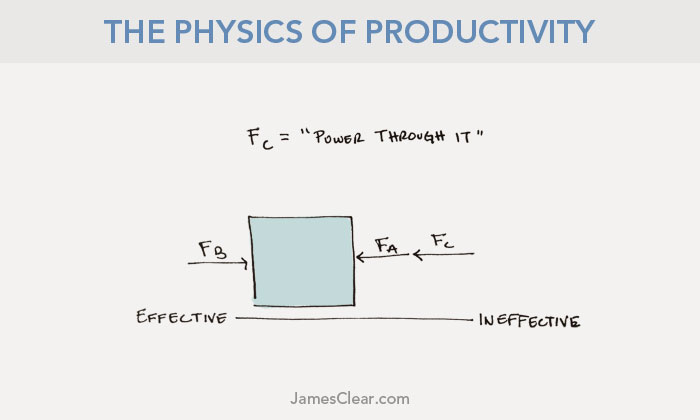
The first option is to add more productive force. This is the “power
through it” option. We gut it out, drink another cup of coffee, and work
harder. This is why people take drugs that help them focus or watch a
motivational video to pump themselves up. It’s all an effort to increase
your productive force and overpower the unproductive forces we face. Obviously, you can only do this for so long before you burn out, but
for a brief moment the “power through it” strategy can work well. The second option is to eliminate the opposing forces. Simplify your life, learn how to say no, change your environment, reduce the number of responsibilities that you take on, and otherwise eliminate the forces that are holding you back. If you reduce the unproductive forces in your life, your productivity
will glide forward naturally. It’s like you magically remove the hand
that has been holding you back. (As I like to say, if you eliminated all
of the things distracting you from being productive, you wouldn’t need
tips on how to become more productive.) [4] Most people try to power through and hammer their way past the
barriers. The problem with this strategy is that you’re still dealing
with the other force. I find it to be much less stressful to cut out the
opposing forces and let your productivity naturally flow forward.
Newton’s Laws of Productivity
Newton’s laws of motion reveal insights that tell you pretty much everything you need to know about how to be productive.
Objects in motion tend to stay in motion. Find a way to get started in less than 2 minutes.
It’s not just about working hard, it’s also about working on the
right things. You have a limited amount of force and where you apply it
matters.
Your productivity is a balance of opposing forces. If you want to be
more productive, you can either power through the barriers or remove
the opposing forces. The second option seems to be less stressful.
I could try
and try with every ounce of my being, but I still would be a lesser
version of you than you already are. I could put all of my focus
into acting like you, talking like you, writing like you, being like
you – and you would still be better at being you than I ever could.
I know that this seems like a silly thing to say because it seems sort of obvious, but I still think it needs to be said. So many of us spend more hours than we probably care to admit to comparing ourselves to others.
We see that they do something well, and we want to do it better. And
when we can’t, we beat ourselves up about it and tear ourselves down for
not being better at ________.
I certainly have been guilty of
comparing myself to others and feeling that I wasn’t measuring up. But
you know what I have realized? Everyone that I have compared myself to would be an extremely watered-down version of me if they tried to be me.
If they tried to write like me or think like me or act like me, I would
always be a better version of me than they ever could. It works both
ways, doesn’t it?
So wouldn’t it make sense then for all
of us to stop trying to be someone that we aren’t and instead focus on
simply being who we already are? Think about how much less energy we would expend if we went about our days just being ourselves.
If we focused on being the best version of ourselves that we could be,
it would still take much less energy than trying to be someone we
aren’t.
The world needs all of us to shine and share our gifts.
So the next time you start comparing yourself to someone else, thank
them for doing what they do best: being exactly who they are. And then
thank yourself for doing the same.
“One reason so few of us achieve what we
truly want is that we never direct our focus; we never concentrate our
power. Most people dabble their way through life, never deciding to
master anything in particular. ” -Tony Robbins
Average Read Time: 4.5 Minutes
This morning I woke up, brewed some Yerba Mate, caught a glorious
rooftop sunrise and proceeded to get more done before breakfast than I
had in the past 4 working days combined.
How about you? How many important things did you get done last week? I
mean the things that actually got you closer to your biggest goals and
dreams.
Take a minute to think about it and write a couple down. How many did you come up with?
For many the answer is few if any at all. Why?
In a word: Distraction.
Lack of focus is the most common killer of making things happen.
In the last 10+ years there’s been an unconscious shift from
encouraging focus to condemning it. It’s happening without us knowing
and we’re all likely victims. As soon as multitasking became possible
and encouraged, our focus died.
Mine certainly did.
We have to fight our very best fight to get it back.
Leo Babauta is leading the charge with his book Focus, which
is more than worth the read. I hit up a sweet barefoot run with Leo
last week where he filled me in on some of the good stuff. Unbelievably
powerful.
Without focus we are headed for disaster and the consequences are as dangerous as they come.
What’s the biggest risk of losing our focus? Wasting our time and living a meaningless life.
The solution is to simplify. Get back to the basics of doing the important.
Here’s a brief 11-step guide to reclaiming insane Focus.
1. Know what actually matters. Be honest with yourself about the actions that truly move the needle in your business and your life. An 80/20 analysis
is a great place to start. If you’re stuck, just think of the tasks you
fear the most–that give you anxiety just to think about. Those are
likely the most important.
2. Pick your top 2-3 core tasks each day. These are
the things that must happen no matter what. If you get these done your
day is a success. Stick to no more than three, or better yet one. They
must move you closer to your big goals. Checking email does not count.
3. Do them first thing. For me writing is one of my
core actions, so I write for an hour or so as soon as I roll out of bed
or after my morning workout (it’s 5:45 am right now). The longer you
wait, the more distractions will intrude. Nothing happens before these
get done.
4. Do not connect to anything until your core tasks are done.
Don’t convince yourself you need the internet or email to do your most
important tasks. 95% of the time you don’t. Leave the internet off and
phone on airplane mode until you crush through the important.
5. Kill multitasking. Stop thinking
it’s more efficient. It’s not. No surfing during phone calls, reading
during meals, chatting while writing. Do one thing at a time. Simple.
Not only is multitasking terribly inefficient but it stresses you out
and it’s rude to anyone around you.
6. Turn off email and notifications (and anything else that interrupts you). When you sit down to do something, nothing else gets attention. Just because someone decides
to email, chat or call you, doesn’t mean it’s more important. Those
things can wait. But if you know they are waiting there, you’ll be too
tempted. Avoid temptation at all cost. We are too weak. I don’t trust myself with email on my iPhone so I totally removed it.
7. Don’t check email in the morning. This is the
most effective (and difficult) single practice I’ve found. I know every
one of you have heard this one. So why doesn’t anyone actually do it? It
will change your life. It feels terrible to know we’ve spent a couple
hours refreshing and going in and out of email without really getting
anything done. I assure you that if you check it, you won’t be able to
help yourself, and you’ll stumble face first into the worm hole. So
don’t even open it until you have a few hours of focused action under
your belt (this is at least 11am for most).
8. Batch your emailing to two times a day MAX. Maybe
30 min before lunch and 30 min late afternoon. If you need an email for
your core task, do not go to your inbox. Go straight to the search
feature and find it. If you need to write an email as a core task (which
should very rarely be the case), write it offline in a simple program
like notepad. Save reactionary items for after you get the important done.
9. Try to get less done in a day–practice Slow Working. Don’t
fill every moment of your calendar with tasks (this is a huge one I’m
working on). You’ll be stressed and rushed the whole day. Slow down and
move through your core tasks calmly. Then maybe you do a few more things
with the remaining time but don’t cram them in. If you do, you’ll
always feel behind.
10. Plan more time for each task. This is the
easiest way to alleviate the schedule. And things always tend to take
longer than we think. If your core task will take you 45 minutes, then
block out 90. Actually schedule it on your calendar. If it only takes
you 40 minutes then suddenly you have free time–how awesome (and rare)
is that!
11. Take breaks and reward yourself. Most of us can
only intensely focus on something for an hour at best. Take at least a
few-minute break every 30 or 60 minutes to clear your head. I love going
up to my rooftop for a couple deep breaths and a view of the Golden
Gate. Find a fun way to get you free and clear. Take a walk, meditate, feed the ducks, breathe, get a snack or some water or listen to an inspiring song. You pick.
Do the above and your day will be a victory before most people wake up.
It’s a pretty awesome feeling. You’ll get way more done than you
planned but your mind and schedule will also be clear to enjoy life a
little more. Few things feel worse than an unproductive day. Nail your
big things early and use that energy to take the rest of the day by
storm. Take a walk with your wife, play with your kids, go down to the
beach and read. Do whatever you want. That’s the point.
Enjoy having nothing to do.
When was the last time you had nothing to do? Many of us can’t
remember. It’s because we set our days up for failure. With more tasks
than we could ever accomplish and loads of wasted time in between.
Filling every second of your day will do this. With the above, you’ll
suddenly have time to spend in your own way. That’s when your mind
really starts to have some fun. The big ideas will begin to show up.
We are addicted to wasting time.
Realize that mindless work is an addiction. It’s just as dangerous as
smoking or alcohol. I’m not kidding. Email, Facebook, twitter, texting,
surfing, news–it’s all a deadly serious addiction. We just think it’s
ok because everyone else around us is wasting their life on it. If
everyone started smoking tomorrow would you start? That’s what I
thought.
The path to freedom can be difficult to see, mostly because the world
is telling you it’s not there. A path begins by walking. These
addictions have caused us to lose our way and most importantly, lose our
focus. We avoid the present. We avoid what matters. And we avoid what’s
right in front of us. Be it a sunset, your husband or that client call
you’ve been putting off.
With pure focus we can be unstoppable.
You’ll get more done in a day than most get done in a week, with time
left over to savor the subtleties of life you forgot you enjoyed so
much.
When in doubt, ask yourself “Am I wasting my time to avoid the
important?” Be honest. You’ll know the answer. Do something about it.
The typical American office worker only does about 90 minutes of real work per workday.
The rest of each workday is largely spent on distractions like
reading the news, web surfing, socializing with coworkers, snacking,
taking coffee breaks, shuffling papers around, processing irrelevant
emails, needless delay tactics, playing games, and daydreaming.
Moreover, American office workers are among the world’s most
productive. In many other countries, even less work gets done each day.
This stat hasn’t changed much in decades, despite massive investments
in time management and productivity training by many companies. We have
more technology to assist us in being productive, but we also have more
to distract us.
The general problem is that we’re still applying an industrial age
model to the productivity of knowledge workers. It makes sense to pay
attention to hours worked if the productive output for each hour is
roughly the same. That may be true for repetitive labor, but it doesn’t
apply much to knowledge workers.
For a knowledge worker, what’s the difference between an hour of peak
productivity vs. a low productivity hour? That peak hour could easily
be 10x more productive in terms of the volume of work completed and the
results generated.
What sense does it make to spend more time at the office if you’re
normally operating at less than 20% of capacity? Why not simply do 90
minutes of real work and then go home for the day?
What if you could complete a whole day’s work in only 90 minutes? What would that 90-minute period look like?
Focus Blocks
Here are some recommendations for having a very productive 90-min period (let’s call it a focus block):
1. Pick one theme – Instead of doing a bunch of
random actions, pick one clear theme for the block. This allows your
brain to load in a singular context and stick with it, which makes you
more efficient. Your theme may be a project you’re working on, a type of
work like catching up on correspondence, or anything that lets your
brain load in one clear context and stick with it.
2. Define the finish line – See your focus block as a
fast dash to the finish line. But where is the finish line? What does
it look like? Having a clear goal that’s only 90 minutes away will help
you focus. Don’t worry if you don’t cross the finish line each time;
it’s there to help you focus, so aim for it, but accept that sometimes
you’ll miss. Some examples: Write and post a new blog entry. Process
items in my email inbox till it’s completely empty. Plan and schedule
all my focus blocks for the upcoming week.
3. List the action steps – List the specific actions
you’ll take during this block. For some blocks this is really helpful.
For others it may not be necessary if the steps are already clear. I
wouldn’t list out my action steps for writing a new article since that
process is very familiar to me, but I’d list brainstorm and
list steps for an unfamiliar new project to make it easier to get
started. Some examples: Delete all obvious spam and clutter from my
email inbox first. Then quickly process all messages that I can
handle in less than two minutes each. Next, sort and prioritize longer
messages for response. Respond to my most important longer messages till
I’m at the 90-minute point. Surrender to the realization that it’s not a
good use of my time to reply to the rest, and just archive them to
empty the inbox.
4. Ensure zero interruptions – Do whatever it takes to ensure that you will not be interrupted
under any circumstances during your focus block. If necessary, tell
people in advance that you will not be available for the next 90
minutes; let them know that you will be available after that. Lock your
door if you can. If you can’t guarantee that you won’t be interrupted in
your current work environment, then do your focus block somewhere else.
You’ll be much more productive and your focus will be deeper if you
know for certain that you won’t be interrupted.
5. Work fast – Think fast. Move fast. Work fast. If you catch yourself going slow, speed up!
Imagine that you’re in a race, and you have to maintain a strong pace
for the full 90 minutes. After that you can rest. With practice this
gets easier.
6. Allow no distractions – During your focus block,
you must do your pre-defined work and nothing else. Keep your cell phone
off. Turn off any notifications that might interrupt you. Turn off your
Internet access if you won’t need it during this block. Do not check
email during this time. Do not take a coffee break or snack break. Use
the bathroom during this time only if you must.
I think you get the idea.
Avoid the Gray Zone and Take Real Breaks
Many people spend their workdays in a gray zone marathon. That’s why
it takes them 7-8 hours to do 90 minutes of work. They work slowly and
inefficiently. Their work time is cluttered with distractions and
interruptions. They begin late and wind down early. Most of the time,
they’re only half working.
Instead of doing a gray zone marathon each day, cycle between real
work and real breaks. This will be much more efficient, even if you work
only half as many hours or less.
Don’t immediately go from one focus block right into another. After
you complete a focus block, celebrate your achievement. Then assess
where you are. Tune into your energy and see how you feel.
If you’re still feeling alert and energized, you may only need a
short break. Take 5-10 minutes to stretch, go to the bathroom, and have
some fresh fruit. Then feel free to dive right into another focus block.
If you feel tired, it’s good to eat something and/or take a nap.
If you feel like doing something physical, go for a walk or take an exercise break.
If you feel like you could use some emotional renewal, you may wish to meditate, socialize, or read some inspiring material.
How long should your breaks be? Make them as long as necessary till
you’re ready for another round of focused work. Sometimes you may only
need a few minutes. Other times it may be wise to take a couple hours
off, especially if the previous block was particularly draining. Between
focus blocks, seek to refresh and renew your energy until you’re ready
to handle another focus block.
Do your best not to load up your breaks with gray zone tasks like
email since that’s more likely to drain you. I recommend batching small
tasks into their own focus block (including email). But if it’s just a
quick one-minute email check now and then, that probably won’t be too
bad, but never do email checks during a block unless it’s critical for
the completion of the block.
Realize that if you only complete one focus block in a whole day,
you’ve still done as much real work as the typical American office
worker does in a full eight-hour day. And if you only complete two
blocks, you’re twice as productive as most. On a super productive day,
you may complete five or six blocks, which is like getting a full week’s
worth of work done in one day.
Do a Week of Work in a Day
During one of the most productive periods of my life, when I was
doing contract game programming work, I’d normally work from 9am to
noon, take a one hour break for lunch, and then work from 1pm until 5pm
or 6pm. But I’d subdivide the work into shorter focus blocks of deep
concentration.
At the start of each day, I’d define the next milestone I wanted to
reach, such as a short list of new features to add. Then I’d make a
short list of action steps in my work journal (just an everyday spiral
notebook). Sometimes I wouldn’t bother to list the action steps if they
seemed obvious. Then I’d program the items on the list. Finally, I’d
compile the software, test the program, fix bugs, and tweak the
implementation until I was satisfied. A typical milestone would take me
about 45-90 minutes to achieve.
Since I was programming games, testing the program meant playing the
game a little to test the new features as well as the overall gameplay.
In effect, the testing phase gave my brain a nice break from designing
algorithms and writing code.
When I finished one cycle like this, I’d feel a nice little sense of
accomplishment. I might take a quick stretch break. Then I’d make a new
list and repeat.
In the morning, I would complete a few of these cycles, perhaps three
of them. In the afternoon I’d do several more. My game projects
progressed very quickly during this time. Every day I added many new
features. I could have a prototype of a whole new game running in just a
few days this way. With today’s better development tools, the work can
progress even faster.
During lunch each day, I took a complete break to restore my mental
energy. I rarely went to lunch with my co-workers. Usually I brought a
sack lunch with me, but I left the office to go eat. I’d drive to a
nearby park, sit on the grass with my back against a tree, and eat alone
in silence. I’d let go of work and just relax. After eating, I’d lie
back on the grass and take a 20-minute nap, or I’d stare up at the sky
and totally zone out. I’d enjoy the breeze and listen to the birds. I
gave the brain circuits I needed for programming work a very restful
break. Then I’d go back to my car, return to work, and crank out a few
more cycles before leaving for the day.
Test, Train, and Experiment
If you aren’t used to a working rhythm of alternating focus blocks
with rest periods, you may need to practice this method for a while to
get used to it. I expect you’ll really like it once you taste this kind
of flow. Doing a full day’s work in about 90 minutes is not only
efficient; it’s also motivated and energizing.
Cycles of about 90 minutes usually work well once you get up to
speed. But you may find that shorter cycles like 45 or 60 minutes work
better for you. You may also find that different cycle lengths are more
suited to different types of work. Sometimes I’ll keep going for 2.5
hours (or more) if I’m feeling good, especially when writing a new
article.
Some people like having scheduled focus blocks with scheduled breaks,
so everything is a set duration. They’re sticklers for starting and
stopping at set times. There’s some evidence that this helps your brain
optimize its performance if your cycles are the same every day.
For instance, you might have focus blocks at 5:30-7:00am,
8:00-9:30am, 10:30am-noon, 1pm-2:30pm, and 3:30-5pm, which would give
you five 90-minute focus blocks with hour-long breaks in between. This
would be a super productive day that would see you doing as much real
work in one day as the typical American office worker does in a week,
but you’re only working for 7.5 hours total.
Other people prefer a more organic approach, deciding based on their
energy levels how low each focus block and break should be. This is how I
work most of the time.
A modest but still highly productive schedule might entail having
three focus blocks per day. You could easily complete a great deal of
work this way. Many top creative workers only work 3-5 hours per day,
but they work with deep focus and zero interruptions during that time.
Don’t succumb to the cultural bias that may try to convince you that
working 8+ hours per day makes you productive. That may be true for
physical labor and some repetitive tasks, but it’s not true for
knowledge workers and creative types. Many people enjoy tremendous flow
and achieve great results by working in short high energy, bursts of
motivation and drive. Try this for yourself, and you may never want to
return to the gray zone of long, unproductive workdays again.
1. Do something different. Go for a walk to clear you head, or
meet friends at the local coffee shop to brainstorm or respond to
questions or to make plans can do you the world of good. Sometimes a new
environment has been the key to increasing productivity and creativity
for me. Just change things around from your normal day.
2. Setting
goals inside and outside of work place are necessary to keep me
motivated. If I am just concentrating on work and not also on my home
life, I find it harder to want to work.
We all need life outside
of our 9 - 5 day. We also need goals for ourselves. You might choose to
learn to cook, learn a new language or speed read. Whatever you choose,
make it something you will enjoy.
3. Create a to do list. I love
lists and highlighting the completed activities makes me happy! Creating
a to do list not only helps you to get your must do's out of your mind,
it also helps you to think clearly as you are processing less
information at any given time. I love that feeling when I get the end of
any tasks that I complete, as it gives me a great feeling of
accomplishment. I can also reflect on this list in the future to see how
I worked through problems if something similar arises.
I write my
list in order of priority. I can then to see the scale of what I am
working on and be able put my to do's in an order to work in with my
day. I usually have several projects on the go at once and this helps me
to be balanced over my schedule.
4. Sometimes there are things we
just cannot do alone this is when we need to ask for help. This can be
one of the hardest things to do, but remember that you can return the
favour one day so it does not all need to be one-sided.
If you are
at work, make your goal a joint effort and get buy in from the team. If
the goal is at home, maybe you could ask your partner, family member or
friend if they would like to learn that new language with you so you
can practice on each other. Two brains are sometimes better than one.
5.
The most important for me is to reward myself when I get to the goal.
Don't fall in the trap of constantly looking for the next thing. Take a
break, reward yourself and those who helped you get there and appreciate
the journey. If you know the reward is coming, it makes it that bit
easier to work towards the big goal at the summit.
I find that the
main thing for me is to chip away a bit every day. It might be to reach
out to someone, write a quick article, remind myself of the purpose or
to read over the plan each morning. The focus of the goal must be big
enough to make you really want it enough to motivate you to move
forward.
Reaching the goals and rewarding yourself will give you
the improved mood and revitalised mind and body that will make you and
your team want to achieve more! Enjoy the process and reaching the end
goal.

 The first thing you need
to do is create a distraction "free" zone. If you can't rent space
somewhere else, like an office, find a space that you can work
uninterrupted for a decent amount of time. Obviously this means you need
to turn off your cell phone and email notifications, close all
unnecessary windows, tabs and don't check Facebook and other social
media.
The first thing you need
to do is create a distraction "free" zone. If you can't rent space
somewhere else, like an office, find a space that you can work
uninterrupted for a decent amount of time. Obviously this means you need
to turn off your cell phone and email notifications, close all
unnecessary windows, tabs and don't check Facebook and other social
media.

 The good news? It works the other way too. Objects in motion tend to
stay in motion. When it comes to being productive, this means one thing:
the most important thing is to find a way to get started. Once you get started, it is much easier to stay in motion. [1, 2]
The good news? It works the other way too. Objects in motion tend to
stay in motion. When it comes to being productive, this means one thing:
the most important thing is to find a way to get started. Once you get started, it is much easier to stay in motion. [1, 2] We all have an average speed
that we tend to perform at in life. Your typical levels of productivity
and efficiency are often a balance of the productive and unproductive
forces in your life — a lot like Newton’s equal and opposite forces.
We all have an average speed
that we tend to perform at in life. Your typical levels of productivity
and efficiency are often a balance of the productive and unproductive
forces in your life — a lot like Newton’s equal and opposite forces. The first option is to add more productive force. This is the “power
through it” option. We gut it out, drink another cup of coffee, and work
harder. This is why people take drugs that help them focus or watch a
motivational video to pump themselves up. It’s all an effort to increase
your productive force and overpower the unproductive forces we face.
The first option is to add more productive force. This is the “power
through it” option. We gut it out, drink another cup of coffee, and work
harder. This is why people take drugs that help them focus or watch a
motivational video to pump themselves up. It’s all an effort to increase
your productive force and overpower the unproductive forces we face.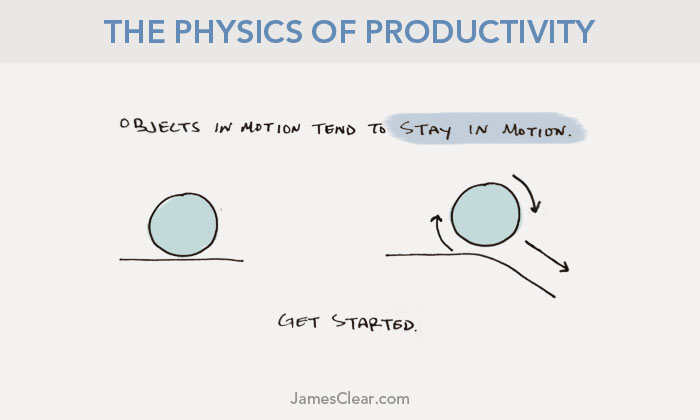 The good news? It works the other way too. Objects in motion tend to
stay in motion. When it comes to being productive, this means one thing:
the most important thing is to find a way to get started. Once you get started, it is much easier to stay in motion. [1, 2]
The good news? It works the other way too. Objects in motion tend to
stay in motion. When it comes to being productive, this means one thing:
the most important thing is to find a way to get started. Once you get started, it is much easier to stay in motion. [1, 2]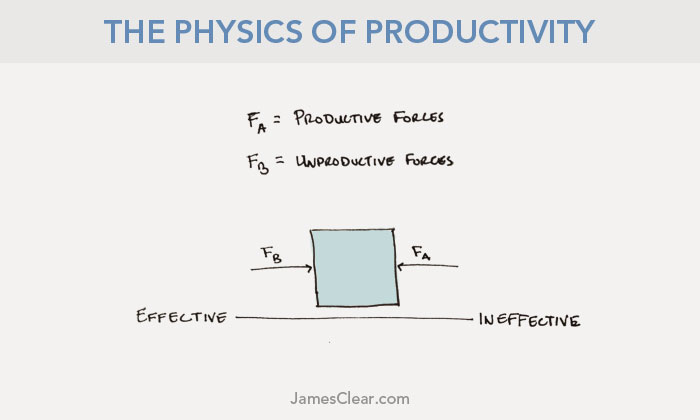


 For a knowledge worker, what’s the difference between an hour of peak
productivity vs. a low productivity hour? That peak hour could easily
be 10x more productive in terms of the volume of work completed and the
results generated.
For a knowledge worker, what’s the difference between an hour of peak
productivity vs. a low productivity hour? That peak hour could easily
be 10x more productive in terms of the volume of work completed and the
results generated. Don’t succumb to the cultural bias that may try to convince you that
working 8+ hours per day makes you productive. That may be true for
physical labor and some repetitive tasks, but it’s not true for
knowledge workers and creative types. Many people enjoy tremendous flow
and achieve great results by working in short high energy, bursts of
motivation and drive. Try this for yourself, and you may never want to
return to the gray zone of long, unproductive workdays again.
Don’t succumb to the cultural bias that may try to convince you that
working 8+ hours per day makes you productive. That may be true for
physical labor and some repetitive tasks, but it’s not true for
knowledge workers and creative types. Many people enjoy tremendous flow
and achieve great results by working in short high energy, bursts of
motivation and drive. Try this for yourself, and you may never want to
return to the gray zone of long, unproductive workdays again. 5.
The most important for me is to reward myself when I get to the goal.
Don't fall in the trap of constantly looking for the next thing. Take a
break, reward yourself and those who helped you get there and appreciate
the journey. If you know the reward is coming, it makes it that bit
easier to work towards the big goal at the summit.
5.
The most important for me is to reward myself when I get to the goal.
Don't fall in the trap of constantly looking for the next thing. Take a
break, reward yourself and those who helped you get there and appreciate
the journey. If you know the reward is coming, it makes it that bit
easier to work towards the big goal at the summit.


